Use shadows as the starting point
Children already know that objects cast shadows. Connecting that everyday observation with a giant instrument gives the visit a clear purpose before any unfamiliar astronomical terms appear.
Delhi’s Jantar Mantar is an observatory made of large masonry instruments rather than a telescope dome.
Published tourism admission and hours checked; September 2026 reporting notes restricted access to parts of structures during repairs. No blanket closure or full reopening date verified.
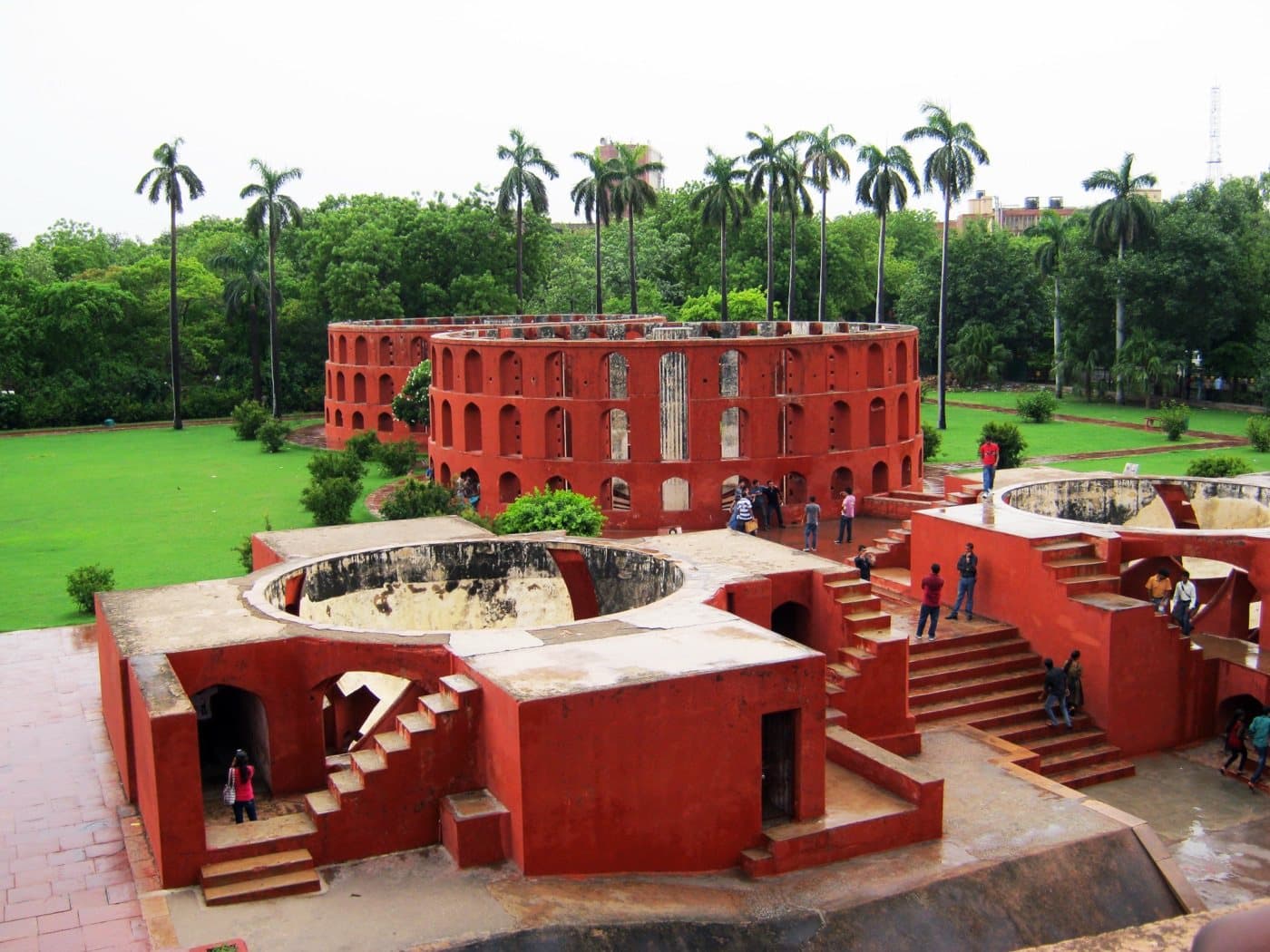
1 photo · Subeesh Balan സുഭീഷ് ബാലൻ · CC BY-SA 3.0 · Photos are representative and may not show current conditions. Credits →
Desk research, not a site visit. Re-check the official notice on the morning you travel.
Delhi’s Jantar Mantar is an observatory made of large masonry instruments rather than a telescope dome. Triangles, curves and open cylinders turn the movement of the sky into measurements. For children, the most rewarding visit follows one question—how could a shadow tell time?—then compares the shapes built to answer other astronomical questions.
Children do not need advanced mathematics. Begin with shadows and familiar shapes. The instruments are protected structures, not climbing equipment, and some areas are restricted.
The site becomes much more interesting when the family looks for a measurement idea rather than treating the instruments as unusual photo backgrounds.
Children already know that objects cast shadows. Connecting that everyday observation with a giant instrument gives the visit a clear purpose before any unfamiliar astronomical terms appear.
The structures can look like adventurous climbing frames. Set expectations early that their shapes serve measurement and conservation, and that current barriers define the visitor route.
Drawing a triangle, bowl or cylinder encourages children to notice how its parts fit together. The sketch can become the basis for a simple explanation afterwards.
Jai Singh’s Delhi observatory belongs to an eighteenth-century effort to improve astronomical measurement. Instead of picturing a modern telescope, ask children to imagine a measuring tool enlarged until people can walk around it. The masonry forms are not arbitrary sculptures: their angles, curves and markings relate to observation. This distinction changes how the site is seen. A family can choose one instrument to understand well rather than photograph every red shape without knowing why it exists. The Delhi site must also be distinguished from Jai Singh’s observatory in Jaipur, which has a different layout and ticket system.
Delhi Tourism: Delhi Jantar Mantar hours and admission · ASI monument documentation via IGNCA
The central triangular form of the Samrat Yantra acts as part of a sundial. Its shadow falls against graduated surfaces, turning the Sun’s apparent movement into a way of measuring local time. Before discussing the scale, ask where the shadow is and what might happen to it later. Children can compare this with the shadow of an ordinary upright object. Do not promise a precise reading from today’s visitor route: surrounding buildings, surface condition, weather and access all matter. Understanding the principle is a worthwhile outcome even when the instrument cannot be used as a perfect clock.
Delhi Tourism: Delhi Jantar Mantar hours and admission · INTACH / World Monuments Fund: Delhi instrument guide
The paired hollow forms of the Jai Prakash instrument represent the sky through a different geometry. The heritage guide explains how markings and shadows helped observers locate celestial positions. For a child, begin with the idea of turning a dome-shaped sky into a surface that can be measured. Why might a bowl be useful where a flat ruler is not? View from the authorised position and use a diagram if available. The gaps and platforms had an observational purpose; their presence does not make them a current invitation to descend or climb.
The Ram Yantra uses paired circular structures with central pillars, while the Misra Yantra combines several measuring arrangements. Children can compare these with the triangular sundial and ask why the designers needed more than one form. The detailed history of the Misra instrument is not identical to that of every other structure, and the heritage guide discusses a possible later addition. A first visit need not resolve every scholarly question. It is enough to understand that astronomy involved different measurements and that an observatory was a collection of specialised tools.
A family can practise the method behind the instruments by noticing a shadow on the ground, estimating a direction or sketching a shape. Ask the child what evidence would be needed to know whether a shadow changes over time. A small notebook can help, but no equipment purchase is necessary. Never look directly at the Sun, and do not use optical devices to do so. Keep any activity on the permitted visitor route and avoid marking surfaces. The protected fabric should remain untouched while the child explores the idea through observation.
September 2026 reporting says parts of Jantar Mantar’s structures have restricted entry during repairs. Confirm the current route at the gate and do not rely on older photographs of people standing on upper levels. If the child expected climbing, explain the difference before arrival: these are historic measuring instruments being conserved. A guide or clear illustrated explanation may be particularly useful when close access is limited, but agree any private guide fee and scope separately. No included daily demonstration or telescope session was verified.
PTI / Times of India: September 2026 structural restrictions
Delhi Tourism publishes ₹25 for Indian visitors and ₹300 for foreign visitors, with sunrise–sunset opening. Two Indian adults therefore have a published admission basis of ₹50, before any guide or other charge. The current child concession and online-category details were not established from that page, so confirm them at the official ticket stage. Jaipur’s UNESCO status, composite tourist tickets and tariff do not transfer to this Delhi site. A photograph of a similarly named instrument in another city is also not evidence of what visitors can access here.
The tourism page identifies Patel Chowk Metro for the Parliament Street location. Check the current exit and approach, especially when nearby street arrangements change. The visit is outdoors, so bring water and choose a comfortable weather window; a cloudy day reduces shadow demonstrations but still allows discussion of form and design. No guaranteed current on-site café or complete accessible route was verified. A seated Connaught Place break afterwards is a practical ending, while Agrasen ki Baoli would add a different kind of engineering subject only if the family still wants another outdoor stop.
Prices, access and programmes can change. Confirm with the operator before setting out.
Jantar Mantar, Sansad Marg / Parliament Street, near Connaught Place, New Delhi 110001.
Search-based Google map. Confirm the public entrance before travelling; this is not a surveyed entrance pin.
No. They are separate observatories in different cities with different layouts, ticket systems and visitor arrangements.
The main attraction is large masonry instruments. No included daily telescope-viewing session was verified.
Yes. Begin with a shadow and ask how it changes; shapes and observation provide a useful introduction without advanced mathematics.
Use only currently authorised routes. September 2026 reporting notes restrictions to parts of the structures during repairs.
₹25 Indian and ₹300 foreign admission. Confirm current online categories and child concessions at the official ticket stage.
Do not expect that. Local solar time, modern clock conventions and present observation conditions differ; focus on how the measurement principle works.
No. Shadows may be less useful, but the instrument shapes, diagrams and history remain interesting.
Their geometry represents the sky on a curved measuring surface, offering a different observational method from the triangular sundial.
No included guide was verified. Agree the price, language and scope of any separately offered guide before starting.
Patel Chowk for the Parliament Street location. Check the current exit and walking approach.
Your first-hand tip helps the next family: the best time to go, where the toilets are, what to skip. An editor reads every tip before it appears.
Desk-checked against linked primary sources on 2026-11-01; not a site visit. Ages, durations and suggested activities are editorial advice. Confirm date-specific access, prices and facilities before travel. Last checked 1 November 2026.
Tell us what has changed: new hours, a price, a closed gallery, a changing table that exists or doesn’t. We check against a source before publishing.
Run Jantar Mantar Delhi? Claim this listing to take enquiries and send us updates. It’s free.
Consider one of these if there is time and energy left. They are alternatives; the route link lets you check the journey before adding a stop.
Indoor
The Museum of Illusions in Connaught Place turns perspective, mirrors and visual cues into an hour of family experiments and playful photographs. Check its own opening and access notes before adding a second stop.
45–75 minutes for a respectful temple visit · Indoor & outdoor
Delhi’s Laxminarayan Temple, commonly called Birla Mandir, is a working Hindu temple on Mandir Marg dedicated to Lakshmi and Narayana. Check its own opening and access notes before adding a second stop.